Showing posts with label Politics. Show all posts

Friday, July 20, 2018

Rise of McPolitics: Once, all politics was local. Now all politics is national. Can we survive the shift?


 I find this long-game history stuff fascinating but if economics is the "dismal science" then politics is scientific dementia. Two steps forward, one back or one forward, two back, ad infinitum. Like a giant brutally oblivious generational pendulum. Race is a crucible. Class is demagogged. Etc. But POTUS as a Russian espionage asset is BIG and unprecedented. Cold War 2.0. Brinksmanship. Can American democracy survive this attack? Hair on fire. Etc.

https://www.newyorker.com/magazine/2018/07/02/the-rise-of-mcpolitics

Thursday, January 28, 2010

you can't be neutral on a moving train


Howard Zinn, historian and political activist, succumbed to a heart attack swimming Wednesday at 87, evoking for me an image of this intrepid champion of the underdog struggling against the current. Something Zinn has done for over a half century with pugnacious wisdom and irascible humor. The linked obituary, although honorable, for the sake of social context, shares Princeton historian Sean Wilentz's critique of Zinn's counter-cultural history of the U.S.: "turning old heroes into villains...after awhile the glow gets unreal." For me, Zinn's people's history made real sense out of the raw deals and broken dreams I'd been dodging my whole life; family and friends losing jobs, struggling to make ends-meet, the strain on relationships. Zinn gives voice to every worker-minority-immigrant-woman-poor-farmer In American history used up and discarded like an old wheelbarrow. In his heart a belief that progress, such as it is, never fast or big enough, is always forged by the leadership of people and not the benevolent concessions of elites chronicled in textbooks. Class war? Fuckin'-A-right! But few can keep up the good fight. The jingoistic Americanism, greedy capitalism, hawkish militarism, the spiritual desolation and widespread social conservatism grinds you down. But not Zinn, swimming against the current until the very end. I don't know that I would have found my way to teaching without his People's History of the United States. For me, Howard Zinn is one of the very few great American heroes. R.I.P.

Saturday, September 12, 2009

Tuesday, August 11, 2009

notes from summer '09 road trip


Drove over 7,000 miles in 19 days, seeing friends and family, watching lots of baseball, eating way too much junk food.

Saw the Boise Hawks play Salem-Keizer Volcanoes; Short Season A ball, affiliates of the Cubs and Giants. The guy who MC’d the betw inning entertainment (usually standing on one of the dugouts w/ cute kids from the crowd or the high school-age girl ushers) carried on like some fringe character from a David Lynch movie: bushy headed, Hawaiian shirt, pot belly, shorts, smarmy prime time DJ banter, something sleazy behind his steely smile. Fun baseball, although more raggedy than the majors, of course. The heckler sitting next to me mentioned a couple of players being almost washed up at 23 or 24. Someone needs to write a book ab some great minor league careers. Not just those guys who finally make it to the Bigs, but also guys who played their whole careers in the minors. The latter including a majority of major league managers today, right?

The shapes and colors of the canyon lands of S. Utah and N. Arizona are striking and beautiful but then you finally get to the Grand Canyon and it is so “grand” it takes your breath away, a miles wide and long and seemingly deep, craggy rock chasm in the earth. I might be one of the last Americans to see it b/c most of the other people there were Europeans.


Santa Fe, NM looks like a pastel beehive splayed across some shrubby desert foothills. On closer examination, however, it’s my first taste on this trip of tourist glitz: guys in fancy shoes w/out socks, women carefully tanned and accessorized, an upper middle class cheesy kitsch to the place. A lot of the art looked like stylized road signs or unused furniture. Georgia O’Keeffe would be embarrassed. All of which I say as if I knew what the fuck I was talking ab after a hour walk around downtown.

So I’m speeding betw Amarillo and Tulsa, banging radio stations betw audio books, when I find two guys and gal talking about health care reform. They say the health care proposals in congress will increase abortions by providing more tax dollars for abortions and/or requiring insurance companies to pay for abortions. Dripping w/ sarcasm they insinuate that the whole health care reform effort in congress is really a stealth effort by liberals, Democrats, so-called progressives, immoral secular humanists to promote abortions. The stuff ab liberal motives is right wing boilerplate crap (can’t you just see James Carville rubbing his hands together in diabolical glee, “More abortions, yes!”). Still, extending coverage to more Americans by sheer numbers alone probably would increase the number of abortions. What is the number of women now who don’t have abortions b/c they don’t have insurance coverage or can’t afford them? So these guys would have us believe that it is more important to prevent abortions (any abortions) than provide every American w/ basic health care, let alone allowing every woman the right to choose whether or not she gives birth. Righteous creeps.

Outside my motel in Tulsa stood a dense orchard of green leafy trees, from which a buzzing whine blared upon my arrival. A ringing metallic sound so startling I stood listening to it for minutes waiting for someone else to come along and explain it to me. I’d heard Cicadas b/f but never this screamingly loud. I would have asked how locals deal w/ them at night, sleeping, but I never noticed them over the air conditioner in my room. Never tried any fried Cicadas, either.

I wish I had taken a picture of people along side the road, sitting on the tailgate of their pickups, the back full of watermelons or some other assorted fruits and/or vegetables, sunflowers, etc.

What makes Busch Stadium is the fans, the sea of red. I liked the country music soundtrack (although I doubt enough that I’ll track any of it down) but that was all they played. And, honestly, the Stan ‘The Man’ Musial statue out front is too cartoonish, looking like some superhero baseball player from The Incredibles.

Parts of north St. Louis looks broken and neglected. Talk ab the recession there would be a cruel joke; it’s always a not-so-great depression in this part of town. Where’s the stimulus money supporting entrepreneurial efforts in these communities? And I don’t mean a Starbucks.

The immense public works in downtown Indianapolis look like this life-size model of classical imperial architecture made out of poured concrete.

The Cubs and White Sox, w/ their combative managers, Lou Pinella and Ozzie Guillen, have to be one of the best rivalries going in interleague play. Guillen, recently said of the Cub’s park, “Wrigley Field is just a bar.” My kind of bar, though. As baseball parks go, it’s charming w/out being ostentatious. The ivy, the spoked, half-wheel steel framing, the bleechers on top of brownstones across the street. You miss all the information delivered by the jumbotrons found at most MLB ballparks and then again you don’t, either. At the field level, anyhow, the aisles are roomier than the tightly engineered sardine can seating found in most newer parks. They serve this frothy pilsner called Old Style. They sing “Take Me Out To The Ball Game” louder than any other park I’ve attended. And, if they win— which hasn’t always been that often!— their victory song spills out into the street. Right, a bar, but a damn good bar.

At the White Sox new U.S. Cellular Field they have an open causeway like at Safeco. That’s where you can see the field from the main concourse all the way around the field. Nice feature. But, otherwise, Cellular feels a little non-descript and generic. Super big billboard ads ring the outfield. It does the job but seems, in Chicago of all places, lacking in character. Old Comiskey Park’s home plate in the parking lot is maybe the best Cellular has to offer.

The thing ab the Chicago style hot dog is that it’s not really ab the dog at all. So it’s 100% Vienna beef, big deal. They are no better than your average dog served at the local Cost Co. W/ the Chicago dog it’s really ab how you dress the dog. Ketchup, which I’m tempted to agree w/, is considered a sin. Instead, they insist upon serving the dog w/ a small salad on top. Not just any salad, though, but this particular Chicago style salad, which is hotly disputed, but goes something like this: shredded lettuce and tomato, glo-green relish, spear of pickled cucumber, sport peppers, and celery salt. They’re good.

Sculptor Henry Moore is one of those kinds of artists so iconic that reaction against his style only goes to affirm his greatness. Abstract, elemental, sexual, all curves, entangled, enveloping beauty; ab presence and absence, isolation and connectedness. Overly serious, perhaps. But always viscerally pleasing.
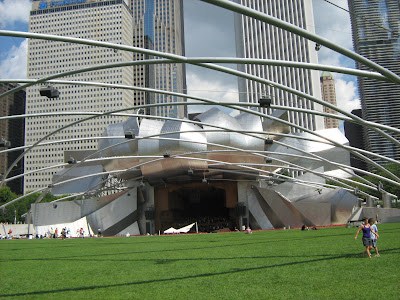

I lucked onto an orchestral music performance at Frank Gehry’s Pritzker Pavilion in Millenium Park. Should not be missed.

On a road trip, McDonald’s is a pit stop oasis b/c of their reliably clean bathrooms. So I’m in one near Milwaukee (some suburban mall expressway). There are at least five TVs in the place, one even broadcast on the mirror in the bathroom! All of them are set to the Fox News Channel. On Fox they’re talking ab the doubts and fears of Americans regarding the health care reform proposals in congress: they’ll ration health care, old and weak people will be euthanized, they’re an underhanded effort by godless liberals to increase abortions, they’re a guvment takeover by a blackcommiesocialist in the white house! Working stiffs, families, old people watch silently, munching down their burgers and fries. People ought to leaflet these places w/ the address for the O Team’s website debunking these industry supported distortions.

Wisconsin is lush, green, and fragrant farmland.

What is it ab big tree-lined streets in college towns like Flagstaff, Ann Arbor, Madison?

The Metrodome in Minneapolis brought back nightmares of the Kingdome. The cavernous concourse; shivering under the interrogation lights of the dome; the superball bounce of the indoor turf; the echoey blare of the sound system. But I saw some good baseball at the Kingdome and the Twins certainly have some storied history of their own at the Metrodome. Besides, they finally move into a new outdoor ballpark next year. It’ll feel to fans like a get out of jail free card. But what will happen to Kirby Puckett street?

What makes the Badlands so bad? It’s not that they are without beauty. The canyons, ravines, colored rocks, plains of prickly shrubs and dusty roads and vast horizons. It’s b/c it is merciless land and you know anybody living there w/out air conditioning would have to be tough as leather. Generally quiet but capable of ferocity like the lightening storms driving along I-90 through South Dakota and Wyoming.

Drove through Yellowstone too fast to see any bears.

Long road trips and audio books are a perfect combination. Enjoyed them so much I tried listening to one at home only to find I couldn’t stay focused w/out the wheel and scenery of the road.

Adventures of Huckleberry Finn: In case you haven’t heard of it, episodic panorama of life on the antebellum Mississippi. Important lessons from the story: fear and desire, equally, make people do stupid things; loyalties often defy common sense; w/out lying life would be dreadfully dreary.

The Old Man and the Sea: ode to heroism in work.

For Whom the Bell Tolls: Always enjoy stories ab the Spanish Civil War, but this one is weighted down by lots of the kind of corny romantic machismo you expect in Hemingway’s writing.

Nobody Move, Denis Johnson: More corny romantic machismo, actually. But also more humor and humility, messy desperation, and gritty sexuality. Good crime novel; good fast-food reading.

In Defense Of Food: Eat food, mostly plants. More leaves, less seeds. Avoid: processing; ingredients you don’t understand; “refined” sugar and carbohydrates (meaning: pop and white bread). Don’t rely on nutritional additives and don’t trust nutritional claims (including “organic”). Grow your own and/or shop your local farmer’s markets. Eat “real” food b/c the Western diet of fast food kills.

The Plot Against America, Philip Roth: What if fascism would have taken hold in America? What if aviator, national hero, and Hitler protégé Charles Lindbergh would have been elected President of the United States in 1940? Story told from the perspective of an 8 year-old Jewish boy from New Jersey. Equal parts funny and fucked up. The story achieves a believable balance of whimsy and tragedy but ends abruptly, leaving an incomplete, unsatisfying feeling.

Cobra II: Peloponnesian War-length account of invasion and occupation (although way more on the invasion) of Iraq. Would-be/should-be lessons learned: 1) The incredible arrogance of Rumsfeld and the Bush Team that they were going to transform the military approach to combat with efficiency management strategies from the corporate business world and “shock and awe” technology; 2) The compelling evidence that the domestic campaign for the war— shoddy intelligence ab WMD’s, trumped up links to terrorism, spreading the expectation that Iraqis would receive American soldiers as liberators, and a stubborn commitment to fighting a high-tech war w/ as few soldiers as possible— cost innocent Iraqi and American lives; 3) The incredible amount of “friendly fire” soldier’s face in combat; 4) The amazing acts of courage by soldiers in combat; dragging comrades to safety under a hail of deadly fire, etc; 5) The lack of adequate planning and commitment to empowering Iraqis to organize and rebuild their own country after overthrowing Saddam was as criminally irresponsible as the manipulations to snooker congress and the American people into supporting the original invasion.


Great way to see the country.

Currently playing:"Street Walker," Michael Jackson

Sunday, May 31, 2009

Star Trek's Multicultural Imperialism


Space... the Final Frontier. These are the voyages of the starship Enterprise. Its five-year mission: to explore strange new worlds; to seek out new life and new civilizations; to boldly go where no man has gone before.

As evidenced by the crew of the Enterprise, the mission has presumably already been accomplished on earth. On the bridge is a veritable rainbow coalition of skin colors, continents, funny accents, and even a guy from another planet, Vulcan, where all actions are guided by (gasp) reason. Created at the height of the Civil Rights era, the original Star Trek projects the 1964 Voting Rights Act into the future: all races, classes, and gender (although women still wear mini-skirts, thankfully) push the buttons and pull the levers of power as a team. It’s the inclusive dream of liberal capitalism (note, again, ship’s name) come true: democracy, cross cultural understanding, and the entrepreneurial spirit of economic development all mutually reinforcing the fundamental human drive for adventure and creative contact with what’s new. And I love it for this reason alone: it rubs wrong the stodgy, narrow conservatism that hates anything new or different (read: people of color, non-Christians, and gays).

Star Trek XI (the first in over a decade) is, in the best sense, a popcorn movie, a summer blockbuster. It’s awesome big, goofy cliché fun, and jumps up and down like an 11 year-old on a can of Monster. I’m no Trekkie but like many who were kids at that time I watched every episode of the original series multiple times as it was broadcasted daily as reruns in the early ‘70s. With that background, I found the prequel vision of the principle characters fun and, particularly, in the case of Spock even touching. Although, I must say, the cameo appearance of the original Spock, Leonard Nimoy, felt gratuitous (if obligatory) and seemed only to ground a film that otherwise warps through space.

(I am left wondering, though, what the uninitiated make of the cheesy character acting? If they like it they ought to check out more of the original because even as fine as Chris Pine is as the brash young James T. Kirk he cannot prepare you for the Shakespearean hambone antics of William Shatner. And if that’s not enough for you check out Rhino Records compilation series Golden Throats for some Shatner and Nimoy musical performances. Show stoppers!)

At any rate, I’m happy to report that in the Star Trek future discrimination, disproportionality and, apparently, group oppression of any kind disappear. Although, unfortunately, bad guys are still around. Turns out some cultures are just genetically predisposed to being meanies; or, rather, not getting enough love as children, for them, has become a cultural tradition, it is not clear which is the case. In the original Star Trek one group of perennial evil doers, the Klingons, look vaguely like Genghis Kahn’s Mongol horde on a spaceship, evoking a murderous cold war Sino-Soviet hybrid. In the latest installment the bad guys, Romulans, look like white supremacists with a tattoo fetish. Nero, their leader, is bent on revenge against Spock and the Starfleet Federation for failing to save his home planet from an exploding star. In either case these baddies are presented as if they’d be welcomed into the Federation if it wasn’t for the simple fact that they’re all haters and can’t get along with others.

This is just about when, if you think about it, the multicult dream starts to sound like a good old fashion whitewash. Or a Benneton ad, might be more like it! Nero and his Romulan gang want to destroy the Federation because of a natural disaster. Right, and Lil Wayne and his posse are bound and determeined to bring down the United States government because of Katrina. Anybody that doesn’t join hands with the Federation (or celebrate the joys of shopping)must be a cracked sociopath; an “enemy of freedom,” a violent actor filled with blind, misplaced hate. This is the appropriation of civil rights goals to rationalize liberal capitalist imperialism: making the structure of power transparent and inclusive to all races and genders (or other marginalized groups) (or at least commitment to the same) renders opposition to the system as negligible— the actions of incorrigible cranks like Klingons and Romulans. In short: it’s a belief that full civil rights can be achieved without any rethinking and reforming of the system that generates economic inequality. Ideologues of the left and right may snicker at this feel good liberalism but its importance as dream making myth rallying support for the status quo should not be underestimated.

This is no mere red state-blue state divide. Even if the republicans drag their feet on policies that promote inclusiveness, and thinly veiled demagogic bigotry remains their chief campaign strategy, any open opposition to the equal opportunity for all creed would spell their decline, if not total destruction, as a major political party in America. From this viewpoint, democrat or republican, civil rights have become the American Dream in that in America everyone, regardless of their background, ought to be able to strike it rich and live like a King in their castle. But this creed ignores the economic origins of equal rights claims. And the consequences of this outlook on U.S. foreign policy is, in short, an inability to recognize (and so confront and reform) the divisive injustice of American imperialism. Team America is seen as at worst a bumbling superpower with good intentions. By contrast, Kim Jong II is a megalomaniacal dictator threatening world destruction as a way to shore up insecurities about his own power. And Mahmoud Ahmadinejad and his Iranian Mullahs view all individual human rights as a conspiracy against the Koran and Islam. Like Klingons and Romulans, these guys were just born evil.

From another viewpoint, however, it is international forces of economic development, beginning with Columbus, colonialism, imperialism, and subsequent mass human migrations, that generated the social ills from which the civil rights movement emerged to correct. It is represented by a democracy for the rich that depends, as viewed globally, on the disenfranchisement and impoverishment of a majority of the planet. It is operationally this amazingly creative machine that makes shiny stuff out of natural resources and human labor but does not take responsibility for its impact on the planet or costs in human life. “Free trade,” the liberal capitalist idea of cross cultural understanding, is a euphemism for: see, you give us raw materials and cheap labor and we will give you Coca-cola and some cell phones. Understand?! Right, Iran’s Mullahs’ are intolerant religious extremists— who rose to power in reaction to the 26 year long U.S. puppet dictatorship of the Shah, who jailed and/or executed any Iranian who opposed him. And, right, Kim Jong is a oppressive, violent, crackpot— who sees nuclear power as the last guarantor of national independence. If the U.S. wants to end nuclear proliferation then, as the country with the largest nuclear arsenal on the planet, it needs to lead in eliminating nuclear weapons, of course. And yet, apparently, this is obvious to everyone except Americans.

Truth is most the action in Star Trek revolves around the apparent conflict between Kirk's guts and glory and Spock's emotionally wrought rationalism. But it's precisely this preoccupation with the unification of an Us against a cartoon, evil Them that grates politically. In all likelihood Nero and his angry Romulans, all miners, had probably been aware of the danger of the exploding star that ultimately destroyed their planet for some time and had been asking the powers that be, The Federation, for help and protection, which they did not receive. And as working class people, working for low pay, they did not have the means to move out of harms way but, instead, to provide for their families, they continued to work in these dangerous conditions. That would certainly present a more credible explanation for the maniacal revenge of Nero but it would also put the whole Star Trek mission in a different light.

Star Trek XI must have started production before Obama’s rise but still what timing. Our first black President. Civil rights, led by African Americans, peaked as a movement at a time when class and economic discussion in this country was polarized by Cold War propaganda. Almost 50 years later we live at a time of another civil rights milestone, almost 20 years after the end of the Cold War, and yet the old either-or discourse on economic issues still seems to prevail. Even Obama’s tepid efforts so far to reform a system of wrecklessly inefficient privatizing profit gouging, demonstrating degrees of wealth inequality not seen since the Gilded Age, are pilloried as socialism. Unions are more than ever regarded as shady unpatriotic special interests that hurt competition and are unwilling to make sacrifices for the good of the country. Meanwhile, corporate (let’s compare the criminal records of union’s and corporation’s some time, shall we?) and banking bad actors are lavished with hundreds of billions of dollars in taxpayer bailouts. Even when the evidence that we need economic reform screams out the reaction continues.

In an important way this is a struggle for the soul of America that goes back to the beginning of the republic and the Alien and Sedition Acts. Concerns over national security push back at efforts to mature, to walk the talk of American ideals, to reconcile civil rights with economic justice, in domestic and foreign affairs. Obama’s recent face off with Dick Cheney is the most recent case in point. To Cheney failing to fight fire with fire, failing to take the fight to our enemies, increases the chances of another 9/11, makes us less safe. In other words, torture and secret prisons and suspension of habeas corpus rights and crony capitalism and executive privilege (i.e., to decide who are our “enemies”) are just what it takes to stay free (meaning: rich). On Obama’s side, torture is a recruitment tool for our enemies, provides unreliable intelligence, and is a profound disrespect to our troops in harm’s way. Etc. And around we go… spinning off topic, democrats brainlessly puffing out their chests for fear of appearing weak on national security.

Civil rights progress is measured as slow, hard-won milestones against a, frustratingly, always receding horizon of full equality, and will do so as long as the causes of gross economic inequality go unexamined and unchecked. In contrast with the liberal capitalist dream, as Martin Luther King put it at the height of the Civil Rights era, it’s still racism, materialism, and militarism that we see tragically reinforcing each other in the modern era. It should be a national embarrassment that the U.S. refuses to participate in the International Criminal Court. In the American imperium, as in the Starfleet Federation, multicultural representation or not, there will always be Klingons and Romulans, terrorists and rogue states.

Currently playing: "Life In Marvelous Times," Mos Def

Corporate Frankensteins: The Final Conquest

By Ralph Nader. Democrats will never forgive him but, to me, he’s still an American hero. (One of only a few, by my count.) And still making a case that someday will seem, we can only hope, obvious to everyone.

Corporate Frankensteins

Currently playing:"For All The World To See," Death

Health Care Newsflash--

The profit motive drives up health care costs!

In addition, while increasing costs it frequently hurts the quality of health care.

(There are times since the “free market” bubble burst last fall it feels like waking from a bad dream. Or at least I hope it’s waking up and not just muttering in sleep.)

The Cost Conundrum by Atul Gawande

Currently playing:"Oh Lonesome Me," M.Ward & Lucinda Williams

Sunday, May 3, 2009

Grading O's First 100 Days


The grading period ended last Wednesday. Grades are due. Another crunch time for teachers. After 100 days, somewhere between a quarter and semester in school time, and admittedly not very much time at all in the grindingly slow speed of democracy in our nation’s capitol, Obama is like the student who you think is doing fantastic. A standout member of daily class. Regularly engaged in group discussions, he always has clever, thoughtful things to say. In collaborative activities he assumes leadership responsibilities, suggesting creative solutions to problems and pushing the group work forward. But then when grading, looking back over records of assigned work (fulfilled campaign promises?), you note they have not turned in much and what they have turned in were the simplest tasks requiring the least effort.

Establishing conservative plans to close Guantanomo and exit Iraq, getting a stimulus bill passed (that is too small), opening relations with Cuba, and releasing some memos that authorized torture during the Bush years. Welcome deeds but nothing very substantial.

Worse yet is when you pause to consider more closely the new Pres’s comments on, say, education, a subject close to my home. O’s stimulus bill includes, reportedly, the most money for education ever in an annual federal budget. One of its stated goals is to reduce job losses in education from the economic crisis. But the losses have already started. Cuts locally are being announced weekly without any word from the feds. Another round of cuts in the school district where I work is scheduled for May 15th.

O has repeated an intention that the stimulus money contribute to reforming our troubled public school system. How? Charter schools and merit-pay pop up in his spare remarks like talismans. Without clarifying details these aren’t just bad ideas but, frankly, old hat and dangerously stupid. Charter schools within the public school system, as alternatives programs (e.g., smaller schools, lower teacher-student ratios, more flexible schedules, etc) to the comprehensive high school, are a fine idea. Both comprehensive high schools and alternative programs have their place and should compliment each other in meeting the varied needs of students passing through the ruthless popularity contest and emotional minefield that is teendom. Charter schools as an end-run around teacher unions, however, by profiteering corporations seeking access to public education funding only undermines public education. (O, BTW, sends his own kids to private schools.) Early reports suggest O’s Education Secretary Arne Duncan might be no better than Bush’s Rod Paige. It’s no small irony that in these times of economic crisis public education is going to be saved, again, by corporate conceits.

Merit pay is an even bigger can of worms. Linking teaching pay to student economics—the lower the student economic demographic the higher the pay— makes some sense: certainly, in my experience, the lower the economic demographic, for a host of reasons, the greater the learning challenges and so the more difficult the teaching work. But so far O’s allusions link teacher merit-pay to standardized test scores. This would be idiotic on multiple fronts: 1) Foremost, the pressure to game the system (don’t forget Paige’s so-called “Texas Miracle”); 2) The contested reliability of standardized testing, in general; 3) The impracticality of linking annual test scores from year-to-year to a teacher without looping teacher schedules (which in the short run will weaken instruction); and 4) The tendency to reinforce the already existing tracking system in most schools that matches the more experienced teachers with the easiest to serve students and young inexperienced teachers with the hardest to serve students. I am really not a standardized test basher; such tests have their place. But at my high school the WASL takes up too much time and over time marginalizes subjects not on the test. Moreover, I’ve been to enough meetings on the subject to know the WASL has wrecked even more havoc at the elementary level. I think standardized tests should be part of a graduation portfolio (with course requirements, GPA, community service, etc), not the high stakes be-all-end-all of graduation. At any rate, tying “merit” pay to test scores, really, just continues No Child Left Behind’s punitive model of school reform and accountability. Neither of these— charter schools or merit pay— are new ideas at all. They are parcel to the privatizing, free market stratagem that is crashing down around us as I write.

At this point, perhaps inaction is the best that can be said of Obama’s education policies. His banking plan, by contrast (and still subject to change we can only hope), is already out there. It would be hard to imagine (although we might see even more over the next few years!) more concrete refuting evidence of the Reagan Revolution’s supply side, deregulatory, privatizing, free market bullshit than the current debacle on Wall Street. But rather than exposing the-- literal-- bankruptcy of this economic model, O seems bent on rallying support for necessary reforms talking the talk while at the same time spending trillions of taxpayer dollars on helping giant banks and corporations continue to cover up their gargantuan boondoggle. Bailing out the banks is crony capitalism; bailing out the auto industry, after its conduct the last 30 years, without the most heavy-handed mandates requiring a green restructuring is just plain embarrassing.

Worst, this government coddling has the bizarre effect of keeping alive right wing boilerplate about the perils of big government and socialism and entitlements when in the current context these canards should appear as merely absurd. Government should be big enough to enforce the rules, takeover, and break-up, if necessary, businesses that have become too big to fail (what could be more anti-free market than this notion of businesses too big to fail?). It should be socialist enough to ensure all citizens have the opportunity to share in our national prosperity and are protected from predatory business practices. And, yes, the citizens of this government are entitled to job opportunities, safe food and water, good health care and education, and a fair legal system. These entitlements are the very reason for the government’s existence. Entitlements of the sort (capital gains tax rates on hedge fund managers, for instance) that have generated the widest wealth inequality gap since the 1920s, and the right fiercely defends, are the ones that gotta go.

The risk here, for Obama, trying to maintain popular support while slathering more butter on corporate bread, is NOT small. Bailing out the banks to the tune of hundreds of billions, if not trillions, of dollars risks running the congressional and public wells dry before it’s time to draw support for the reforms necessary to reestablish a regulatory structure that rewards hard work and honesty and rebuilds a green based manufacturing economy that can support a living-wage working class. It’s a risk that is wrongheaded at best. Some, I know, say taking on Wall Street would be political suicide. I don’t believe this and, if not now, then when? And if not ever than things are as bad as some say.

Oh yes, this is what any leftie worth their salt would have said was inevitable given the Clinton team (including Wall Street insiders) O has teamed with in the White House. But I’m not ready to give up on Obama. If we get out of this presidency with a reasonable semblance of affordable universal health care and carbon limits factored into the economy he would be the best president since before my time. And, perhaps I’m grasping at straws, but I see something significant in the video above when Summers gives Geithner a look in the background just as Obama says that when banks play chicken with the government on bailouts he sides with workers and consumers. I still think that with the right leverage O might take a stand and provide the leadership necessary to turn his words on the economy into deeds. Not just because I think O has more to offer in terms of leadership than Clinton did but because in the world today, the pieces are there, financial collapse, threadbare infrastructure and safety net, looming environmental crisis, worldwide pressures from the have-nots, and the time is right for a paradigm shift. Messy, lurching, full of denials, it feels like we’re already in one now.

Like much of America, I’m still charmed by Obama like no President before. I’m still holding out hope that O is the man to lead us out of this wilderness. (And if I’m wrong I had hope for awhile and let it animate my actions.) For now, I recommend President Obama come in after school to catch up on his homework and get some extra tutoring support. Good luck.

Grade: C-

Currently playing: Robyn "Don't Stop The Music"

Tuesday, April 21, 2009

Torture Porn in the U.S.A.


I’m a squeamish horror fan at best, preferring suspense to torture-porn, so I haven’t followed U.S. forays into torture since 9/11 as closely as one might, but this is a story that should not be missed. An assortment of security officials are sitting around a table in ’02 establishing policy. Hundreds of enemy combatants have been apprehended but no one knows what to do w/ them. After some talk, it’s decided that b/c they’re Muslim fundamentalists the only form of interrogation they will respond to is extreme terror. Some guy at the table knows somebody in a U.S. military unit that submits special operations military trainees to torture techniques they might face if captured. So, some legal documents are drawn up and authorized by Bush and Cheney, a manual is distributed, and interrogators start going to town on detainees w/ waterboarding, etc. Six years later NOTHING substantial comes out of these interrogations. And, after some recent investigation by some NY Times reporters, Scott Shane and Mark Mazzetti, it turns out the torture techniques were long discredited relics used by communists during the Korean War. Evidence abounds that the techniques used rarely elicit truth but, in fact, tend to drive detainees to confabulate stories. The mix of hubris and extreme stupidity in this story is astounding. It’s like something right out of the Manchurian Candidate and yet not completely surprising when the ruling ethos of American leadership in crisis is more concerned w/ appearing to be doing something, anything, appearing to be men of action, rather than actually taking the time to do the right thing. It’d be funny if it wasn’t for the torture victims and the shameful human rights example this episode has presented to the rest of the world. Meaning, it's not very funny at all.

In Adopting Harsh Tactics, No Inquiry Into their Past Use

Sunday, April 19, 2009

Tea Party for Kooks, Demogogues, and Right Wingers


I’m almost relieved to learn the Tax Day Tea Parties were organized by Fox News. Watching reports, listening to people’s complaints, checking out the anti- government spending signs, I'd hate to think this was a honest-to-goodness grassroots movement. But if the O Team’s bank plan doesn’t work this Astroturf happening might still grow organically into something more. (Even if it makes even less sense than O’s bank plan!) Obama is already lowering taxes for 95% of Americans, or so he’s said so upteen times, so the anti-tax angle makes no sense. And government spending and deficits, right now anyway, are NOT our problem. Sure, what the government is spending money on— bank bailouts instead of more stimulus (that creates jobs, redirects the economy to green manufacturing, cuts corporate profits out of health care costs, etc)— that would be worth raising a ruckus about but I didn’t see a sign or here a peep ab that. There is a crackpot conservatism afoot that behaves like the housewife continuing to make the bed and dust the day after Armageddon. Karl Rove, in the Wall Street Journal, suggested the other day that Teabaggers go back to Reagan basics, getting the word out about the value of tax cuts and lowering government spending to stimulate the economy. Uh, the jig is up on the supply side cant, guys. First, right, this isn’t the time to be raising taxes, but lowering government spending when consumers and businesses aren’t spending is just plain stupid. And, in general, smaller government, or stripping the government of its ability to officiate what bankers do with other people’s money, more specifically— the Reagan Revolution— is a big part of what brought about the current catastrophe. If, like me, you find your blood boils at the idiocy of this stuff, check the Robert Reich link below for the cool reasoning you need for family and that guy at the coffee shop (or the cute chick who takes pride in reading cue cards).

A Short Citizens Guide to Kooks, Demagogues, and Right-Wingers On Tax Day

Thursday, April 9, 2009

Oil Giants Party On

You know all those ads on TV in the past few months peddling the notion that the oil companies, Shell, BP, Chevron, etc. are way committed to developing a greener, more sustainable energy future for us all? From a piece in the NY Times today called, “Oil Giants Loath to Follow Obama’s Green Lead”:

In the last 15 years, the top five oil companies have spent around $5 billion to develop sources of renewable energy, according to Michael Eckhart, president of the American Council on Renewable Energy, an industry trade group. This represents only 10 percent of the roughly $50 billion funneled into the clean-energy sector by venture capital funds and corporate investors during that period, he said.

Until businesses are charged (yup, that means taxed!) for the carbon dioxide emissions they generate there is little incentive for them to diversify. The “free market” is a free-for-all that leaves a mess for others to clean up. For the oil giants, it’s like they get all the door receipts for puttin’ on a big party but don’t have to pay for any of the clean up. There is still way too much profit to be made from oil to waste their time and money on anything else, whatever the consequences to the planet.

Monday, April 6, 2009

Ending Banker's Holiday: Greed and Stupidity


In a column last week, “Greed and Stupidity,” NY Times columnist David Brooks outlines the development of two narratives to the economic crisis. One, called the greed narrative, locates the crisis in the overreach of an investment banking Wall Street oligarchy elite, growing from 16% to 40% of corporate profits betw the ’80s and this decade, and extending its power into government. Brooks cites Simon Johnson as chief explicator of this narrative. The second, called the stupidity narrative, suggests the collapse was caused by an over-reliance on the diversifying trick of securitization (bundling and reselling loan assets) and inflexible mathematical models that ignore inevitability of historical shocks and the unexpected tendency of the internet to accentuate runs. Elaboration of this position is provided by Jerry Z. Muller from right-wing think-tank the American Enterprise Institute. The odd thing ab this supposed narrative split is that if you’re even casually familiar w/ the literature tracking the crisis you’ll note that the stupidity narrative is already part of the greed narrative. Brooks even admits that the reform measures for the financial markets proposed by both narratives are more or less the same, with one important exception. The greed narrative describes an insider, collusive, dysfunctional relationship betw Wall Street and Washington (Geintner, Summers, Bernanke, etc). To effectively recover from the current mess, Johnson argues that it is essential to sever the backroom ties betw Wall Street and Washington, nationalize and breakup and reorganize the banking system so that banks can no longer be too big to fail. Meaning, at least temporarily, a bigger government role. This is anathema to Brooks and conservatives raised on 25 years of Reagan Revolution free market BS, who, at this point, sound like flat-earthers. Even if we got into this crisis b/c of arrogant Wall Streeters who didn’t know what they were doing it’s those same people now in Washington serving up the weak sauce concerning the bonuses and sheisty accounting rules and black hole bailout plans. Brooks would have us believe that changing a few rules and recapitalizing (meaning: more taxpayer bailouts) will do the job. Even if Wall Street hubris has got us into this mess we should still fear even more Washington hubris, argues Brooks. All of which just seems like fodder to extend the dithering by the O Team and stem the tide of calls for breaking up the Wall Street lock on Washington. Meanwhile, job news is increasingly dreary; 663,000 jobs lost in March. Unemployment has reached 8.5%; the underemployed (that includes people w/ part-time jobs who’d rather be working full-time) is over 15%. News from the Washington state proposes huge cuts in public education. Everyone at work is bracing for layoff notices in May.

Tuesday, March 31, 2009

End Banker's Holiday: Part Five


Like a wreck on the highway, I can’t look away. The budget in public education always involves minor cuts and the threats of bigger cuts but this was the most tense budget year since I started teaching. By now everyone knows someone who has been laid off or someone who had to keep working and put off retirement. Shanty towns are popping up, Seattle has their own Nicholsville, named after our reputably heartless mayor. There’s not much humor to squeeze out of this crisis. It makes me nervous, edgy. But there is a Pynchonesque novel of names like Glass Steagall and securitization and Black Scholes and credit default swaps and Brookley Born and derivatives and Ayn Rand and subprime mortgages all swirly w/ simple dreams and fathomless gall. Three early chapters follow. If you haven’t already, check them out.

The End, By Michael Lewis


The Reckoning, By Peter S. Goodman


The Quiet Coup, By Simon Johnson

Thursday, March 26, 2009

Zombie Media at Obama Press Conference


If, like me, you found yourself shaking your head at the softball (or even downright head scratching) questions the media served up at Obama's latest press conference then check out Leslie Savan's response over at The Nation. Spot on. (Also, one of my favorites writing about pop culture.) When NBC's Chuck Todd asked what sacrifices Obama wanted the public to make to solve the economic crisis I had to scramble to find something to throw at the TV. Grrr.

(The Nation.)

Saturday, March 14, 2009

Iraqi Hero Goes To Jail


"This is a gift from the Iraqis. This is the farewell kiss, you dog. This is from the widows, the orphans and those who were killed in Iraq."

Iraqi journalist Muntadhar al-Zeidi throws a shoe at President George W. Bush during a new conference in Iraq last December.

(Los Angeles Times)

Monday, February 23, 2009

Ending Banker's Holiday: Part Three (A Rant!)


This morning on This Week this guy, George Stephanopoulos, asked those sitting ar a table, George Will, Paul Krugman, and economist Nouriel Roubini (aka Dr Doom b/c he prophesied the housing crisis 15 minutes b/f it happened)(and some lady from Business Week I don’t know), if there ought to be established something like the 9/11 Commission to learn from the current economic crisis. Everybody was non-committal to dismissive, Krugman saying sufficient discussions were already taking place. His slightly bashful dismissive was hard to read. Was he smirking about the wasteful, ineffectuality of the 9/11 Commission? Or does he really think there is nothing policy-wise to be learned from the current mess?

Soon enough the conversation veered towards a table response to this very desire to blame someone or something for our current problems. (Who needs a Commission?!) A consensus ar the table quickly emerged to make the point that 300 million people in America (and another 300 million in Europe, Krugman added) were all responsible for going on a “25 year credit spending spree,” saving little and spending beyond our means. Really? That’s the ultimate cause of the biggest global economic crash since the 1930s? We were all just maxing out our credit cards too much?

Now it’s not that I don’t think there shouldn’t be consequences for not paying your debts but didn’t congress already establish what many consider quite harsh, unforgiving bankruptcy laws in 2005? B/f the crash? And I’m not suggesting that people who took on mortgage debts they couldn’t pay shouldn’t be held responsible. But isn’t there a sense of proportion here we’re missing when pointing fingers at millions of working people for receiving 70 billion in subsidies while four or five banks will be lavished w/ up to 2.5 trillion? So why have people gone on a 25 year credit spending spree, anyway? Might it have anything to do w/ the fact that real working class wages have not risen since the 1970s?! (U.S. Bureau of Labor Statistics)

Wouldn’t it be far more accurate to say that this crisis is the result of 25 years of supply side economics that were supposed to trickle down to the rest of us but never did; that this crisis is the result of 25 years of “free market” deregulation and predatory casino capitalism fed consumer pipe dreams and Scroogy anti-labor demagoguery; that this crisis is the result of a 25 year surge in income inequality of staggering numbers not seen since the Gilded Age? (The Height of Inequality)

And wouldn’t it be important that this be said so that we might not repeat this catastrophe again? So that we might not have the same self-serving assholes that led us into this mess continue in their machinations from positions of power? The length and depth of capitalist cyclical downslides were significantly longer and deeper (during the Gilded Age) before the Depression precisely because of the sweeping government interventions and social safety net measures established by the FDR’s New Deal. It wasn’t just a bunch of government bailouts of failed industries. Now in the biggest free-fall since the Great Depression are we going to forget that?!

I’ve read it suggested that this cover-up recovery is b/c the Wall Streeters gave more money to Obama’s campaign, reportedly 10 million plus (CounterPunch), than any other constituency. But Obama amassed the biggest campaign funding war chest in history. Over 700 million or something like that. Why would 10 measly million buy so much influence? Please let this be the media chatter drama of the moment, the left’s unreconstructed doomy fatalism, the last bleats of the Right’s dying free market fundamentalist ideology, and Obama’s careful, patient, measured steps to right the ship of state. B/c this growth model, Wall Streeters hustle a bubble like mad, then go on bonus junkets to the Caribbean, while Main Streeters take it on the chin, chewing on their own pride in austerity and sacrifice, can’t last. Eventually some angry, smart young people will rally a mob to tear the whole thing apart. And it’ll be fun while it lasted for those who hit the jackpot. But there will be hell to pay for the rest of us.

Tuesday, February 17, 2009

Ending the Banker's Holiday: Part Two


“Politics are hard to predict,” Lawrence Summers
(aka “The Professor,” Obama’s Chief Economic Advisor)

So the first attempt by the Obama team to address the banking crisis last Tuesday was a bust. It didn’t even please Wall Street, who at this point would seem to be the only constituency being given any serious consideration. I was hoping for better but, knowing what they had to offer, Summers and Geithner could not anticipate this political reaction?! The closest to an actual “plan” was barely distinguishable from ideas floated by Henry Paulson and the Bush team last fall. And still hung-up on the same question: what price should the public pay for the “bad” assets amassed by the banks?

“Markets are a great way to organize economic activity,
but they need adult supervision.” –Wall Street Journal

Most distressing is the contrast between the Obama team’s dithering and what is emerging from smart Economists as a few obvious needed steps to be taken:

1) Quit the charade to—what?— fit some myth of private ownership that has always been a gross distortion of American history anyway. Nationalize the banks, even if only for a temporary period. It is an insult to taxpayers to pour hundreds of billions of public money into the private banks black hole, from 450 billion (Krugman) to 2.5 trillion (Reich), without any means to exercise control over how the banks spend that money. On the one hand, 18 billion paid in bonuses to bank managers since the meltdown is small potatoes; on the other, it is indicative of the fact that these people do not operate in the world where the rest of us live, where people actually have to work for a living, and is a flagrant slap in the face to the public bailout. These are NOT people we can trust to make Wall Street work for Main Street, duh.

2) Many agree that a crucial tipping point in our current predicament was the repeal of the Glass-Steagall Act in 1999. This Depression Era legislation set rules about the appropriate business of banks and established boundaries to avoid conflicts of interest in the financial sector. Its repeal— ratified by the Clinton-Rubin team, lest you’d like to blame all this on the Bushies—unleashed unsavory links between investment banks and junk money managers and fraudulent real estate mortgage companies. Prior to the repeal subprime mortgages constituted 5% of the real estate market; by 2006 the number had reached 30% (Wikipedia). Capitalism is by definition cyclical, alternating between bull runs and bear markets, but it’s the repeal of Glass-Steagall that has blown this most recent bubble to such gigantic, at this point still seemingly bottomless, toxic, world-wide proportions. (CounterPunch.)

3) The crux of this bubble trouble was the simple fact that Wall Streeters and their minions were making beaucoup dollars selling and reselling debt assets without any personal financial risk, without having to maintain any minimum of capital to debt ratio, let alone any responsibility for reporting these tenuous financial arrangements. The credit rating agencies whom should have cried foul failed miserably. Even though as early as ’03 Warren Buffett and a few other prominent members of the business community were calling unregulated derivatives markets “timebombs,” the Securities and Exchange Commission, our government watchdogs, did nothing. Perhaps the poor reception on Wall Street to the Obama team’s vague, tepid plan indicates that at this point even a majority of Wall Street has had enough of this insider’s game. How could we expect the Wall Street elite— including Geithner and Summers— to reform themselves? It’s time to clean house, closing the revolving door between Wall Street and Washington, establishing new independent government oversight that will reestablish rules that reward hard work and honesty. Isn’t this what Obama promised he’d do anyway? (Baseline Scenario.)

Steps 1 and 2 seem inevitable if it wasn’t for the dithering. But can they be carried out substantively without step 3? None of this should be surprising after watching Obama select as his economic advisors, one after another, from the Clinton team. A group as responsible as anybody for setting the stage for the current debacle. And, still, I want to hang on to something in Obama’s rhetoric. The stuff necessary to finally ending this second Gilded Age out of the simple, sober recognition— breaking with the supply-side, trickle-down delusions of the Reagan Revolution— that a healthy middle class is the most important investment for long-term economic growth.

Saturday, February 7, 2009

Mr. President: End Banker's Holiday


Okay, it looks like some kind of stimulus bill spending near a trillion dollars is going to be passed soon. This is necessary. Consumers have stopped consuming. (Or reduced consumption significantly.) Demand is down, so production slows, and jobs disappear. Government spending (as opposed tax cuts, BTW) is the surest way to stimulate demand and create jobs and so increase consumer spending and consumption.

But don't we need to consume less? Aside from the lost jobs, might not that be a good thing for environmental reasons? In the long run, yes; it's necessary. But better we make the adjustments to a more sustainable economy gradually or at least consciously, in big reform responses to shocks to the system like the current one. The miseries in terms of job loss and poverty visited upon the vulnerable by doing nothing ab the current crisis are not something I want to see. The press mentions the possibility of 10% unemployment w/ a shudder. I don't know how dire that'd be; I lived through 11% in the early '80s and I don't remember much looting and killing. But what would 20% (it was supposed to have reached 27% at the depth of the Depression, and unemployment statistics are notoriously known to be lowball)look like? Protests in the streets, to be sure. More crime and violence, undoubtably. Child hunger? Impoverished seniors? Increased homelessness. Etc.

We want to rebuild now, get people back to work and spending, w/ programs/projects that move us towards a sustainable, green economy. And government spending is the best way to get the job started. Right now, the only way.

What I don't get is how come in the partisan stimulus debate there has been virtually no discernable talk ab what's going to be done ab fixing the financial markets that started the collapse?

Last night all the talking heads, from both sides, were going on ab how "ordinary Americans" feel ab the stimulus package, desires for jobs and tax cuts, fears of big government and deficits, etc. Right, people want jobs and job security, they want to know that what they have is still going to be worth something tomorrow. But what's hanging over the stimulus debate is the fact that Wall Street, the very people who started this titanic mess, have already been given hundreds of billions of dollars w/out any accountability; w/out any indication that the bailout fixed anything; without any sense that the bankers get that their wreckless gambling w/ "other people's money" is "shameful," unacceptable.(See link.)People want to know that this is not the foxes guarding the hen house.

The right has for the moment gained traction w/ their own standby, accusing Obama's plan of fatcat Liberal spending. Under the circumstances the argument is beyond stupid, it's dangerous. But they've been able to do this largely, I think, b/c ordinary Americans don't get why banks are getting hundreds of billions of dollars w/ no strings attached while working people continue to lose their jobs and homes. Limiting CEO salaries seems like the right thing to do, apoligizing for nominating a guy who has been in bed w/ the industry he's supposed to bring under control, okay, but this is little more than defensive PR window dressing.

The first thing Franklin Roosevelt did during the Great Depression was shut down the banks and have them audited. Then he started the Federal Deposit Insurance Corporation which, basically, required banks to hold at all times some percentage of their deposits. This is widely understood as returning stability and trust in the banking system. Not coincientally the crux of the present catastrophe has a similar ring: "loan originators retain no residual risk for the loans they make, but collect substantial fees on loan issuance, which causes unchecked degradation of underwriting standards." (Wiki) Let people play w/ other people's money and they will eventually gamble it away. Obviously, we need some new rules, and credible, transparent, independent enforcement of those rules. But nothing substantial is being done.

Ordinary Americans may not understand tranches and CDO swaps but they know that the build up to the current economic catastrophe has been an insider's game. Obama's economic team is all insiders but he got elected, at least in part, b/c he promised to change the way the government does business in Washington, to uncouple the unhealthy relationship betw big business and politics. He has believers in ordinary Americans but he needs to convince Wall Street before he loses Main Street. Do so and old arguments ab liberal spending versus tax cuts, supposedly hanging up the stimulus bill will stop getting in the way.

Monday, January 26, 2009

we voted for who we liked


“You can vote however you like,” sang the kids from Bob Clark Academy of Atlanta, Georgia. And we did. We elected Barack Hussein Obama 2008. This simple fact alone is worth savoring. But the boo birds— critics, bless ‘em— are at it already, of course. One of my faves, Paul Krugman, of the New York Times calls Obama’s inauguration speech muddled, its central argument— we need a return to responsibility, says Krugman— the same milquetoast argument Bush made in 2000. But the responsibilities Obama calls for could not be further from those advanced by Bush, right?! Just review the speech.

Consider foreign affairs first. Rejecting as false a choice between our safety and our ideals, Obama points out that our “power alone cannot protect us, nor does it entitle us to do as we please” around the world. Instead, the best way to extend our power and provide leadership is by the “justness of our cause, the force of our example, the tempering qualities of humility and restraint.” How could he repudiate any more explicitly the Bush Doctrine of pre-emptive strike and blundering militarism than with the argument made here? As I recall, this was precisely one of those moments during the speech when the camera panned to Bush with a humiliating wince. The contrast was certainly not lost on Bill O’Reilly and the other leading attack dogs of the right who have been fulminating about the implication of Obama’s remarks since the speech.

On the economic front, admittedly, Obama’s arguments aren’t always so straight-forward. He says of our current economic crisis that it is “a consequence of greed and irresponsibility on the part of some, but also our collective failure to make hard choices and prepare the nation for a new age.” Is he referring to our collective thirst for gas guzzling SUVs and, in general, the failure of consumers to demand the products of a green economy? This is a collective failure, to be sure, but it’s a bit obfuscating to link this directly to our current economic crisis. Government spending to stimulate the sagging economy should do whatever possible to lay the foundations for a sustainable green economy, for future generations, for the sake of the planet. But the lack of development in this direction has little to do with our current economic crisis. This is, literally, the bankruptcy of the deregulating “free market” philosophy that has held reign through republican and democratic administrations for almost thirty years.

Still, again, there is no mistaking Obama’s notions about our responsibilities to the market economy with those of Bush. “Without a watchful eye, the market can spin out of control,” says Obama. He continues, “A nation cannot prosper long that favors only the prosperous.” I’ll take this as an acknowledgement of one of the bitterest ironies of Bush’s and supply side economics in general. On the one hand, in the name of his “Ownership Society” Bush actively pushed for policy measures that would increase mortgage lending and home ownership. Such noblesse oblige, every American ought to own their home, right?! Unleashing entrepreneural energies from stifling rules and regulations creates wealth that trickles down to everyone, say supply-siders. Let innovators innovate, let the moneylenders make money. But, on the other hand, like every other Administration in the wake of the Reagan Revolution, the Bushies advocated anti-labor and other so-called “free market” policies that eroded the incomes of average American families. A lack of public oversight rewarded those without scruples to swindle paychecks and gamble wrecklessly with other people's money. Or, in other words, reduced the ability of most Americans to pay for their home mortgages!

Obama seems to get this but it would have been nice if he would have elaborated on his case for a more watchful eye. And, frankly, skepticism about his remarks in this area will remain until actions overcome the fact that most of his new economic advisors are old Wall Street heads (or the proteges of them) who under Clinton promoted more of the deregulations that have bred the gargantuan investment scams that are at the heart of the current economic meltdown.

Finally, culturally, Obama counts our “patchwork heritage” (as opposed to a melting pot of unity) as one of our enduring strengths. The overtures to Muslims and poor people the world over, in an address to Americans, struck me as probably unusual? We cannot ignore suffering outside our borders, Obama says, “nor can we consume the world’s resources without regard to effect.” We may not plan on apologizing to anyone for our way of life, as Obama asserts, but when is the last time a U.S. President has suggested we need to take more responsibility for our consumption of world’s resources?

Sure, Obama appeals to our sense of responsibility and sacrifice, hard to imagine an inaugural that wouldn’t. But I’d say his central argument is that key to America’s recovery from threats abroad and collapse at home is a return to the values of “hard work and honesty, courage and fair play, tolerance and curiosity, loyalty and patriotisim.” I repeat, these are NOT Bush’s responsibilities of "family values" and big business cronyism and shock and awe to any "freedom haters" who might oppose us!

At the risk of perpetuating the inflated analogies with Lincoln, seeing some of the response of the right and left since the inauguration, made me think of how both the abolitionists and slavers were typically reviling Lincoln. This is probably just the beginning.

Be honest, even those of us pulling for Obama did not think this was likely, if possible, one year ago. Whenever politicians huff and puff about America’s great diversity and opportunity I’m always reminded of the incredibly narrow demography of our presidents: every president of the U.S. has been, white, male, and not just Christian but decidedly Angloid protestant, except one. It’s astonishing what percentage of our presidents graduated from either Harvard or Yale. So our first African American president reassures elites with his Ivy League training and protestant church commitments and manly-manness (that Hilary was a scary ball breaker, right!), but, still, seven years after 9/11, the Patriot Act, two ongoing quagmires against Muslim enemies, and this country elects a black guy named Barack Hussein Obama?!

It’s cracked the smooth, hard shell of cynicism of living my entire adult life in the wake of the Reagan Revolution. Ladies like the one who told McCain at a rally late in the campaign that Obama frightened her because he was a Arab, a Muslim. I really thought there were too many of them, or too many of them that voted. But, in the end, even my parents voted for Obama. Don’t underestimate the people. (Too bad Walter Karp isn’t here to see this.)

I’m not saying calls to our enduring ideals cannot feel stale, but if a man “whose father less than sixty years ago might not have been served at a local restaurant” can’t revive these values as enduring bonds between us, giving us direction and purpose, who then possibly could? I’m aware of the naysaying from some of my favorite naysayers at Counterpunch and Eat The State but I’m not ready to let go of a sense of hope I never thought I’d feel again. This is the moment of a paradigm shift. Is Obama up to the job, I don’t know. But I can’t think of anybody better for the job. Can you?

Sunday, January 4, 2009

Bush Shoe Epitaph


What will be the fate of the Bush Doctrines, the stuff Palin thought was some book she hadn’t read, of “unilateralism,” “preventive war,” and “democratic regime change” once Bush is gone?

Unfortunately, unilateralism has been a feature of U.S. foreign policy for awhile, b/f W. The U.S., during Clinton Administration, Bush the Elder, etc has refused to sign or ratify hugely popular international agreements on climate change, landmines, and the rights of indigenous people. People often forget when Clinton bombed locations in the Sudan and Afghanistan in 1998, in retaliation for the bombing of the U.S. embassy in Kenya, and w/out any UN Security Council authorization. During the campaign Obama said w/ reliable evidence he’d strike against Bin Laden or Al Queda with or without the authorization of the UN or even Pakistan. Unilateralism and preventive war remain the prerogatives of superpowers for the foreseeable future.

But, at least, with this shoe episode can we agree that the tragically preposterous proposition of imposing “democratic regime change” by military invasion is once and for all dead? During the campaign McCain hammered Obama for not conceding the success of the surge strategy in Iraq. Obama remained mum but Biden, by proxy, made the essential point that surge was tactical. Meaning, the goal of the surge was to reduce the violence so that Iraq’s leaders could come together politically. Have they? McCain and the Bush Administration, missing this point, remain mired in the arrogant imperialist delusion of the military solution. But they lost.

So has the regime change by military invasion strategy lost, too? Some argue the right’s surge success argument is a setup so that when all hell breaks loose when the U.S. does finally pull out it’ll be blamed on Obama and the Democrats. Thus, reviving that old Vietnam canard that we “lost” b/c we didn’t support our troops to victory. Gawd.

Apparently, the Iraqi shoe guy, Muntander al-Zaidi is a Sunni, Iraq’s Muslim minority; a former Baathist, Saddam’s political party. What is going to happen when we stop “occupying” Iraq? Will the Shia, Sunni, and Kurds find a way to cooperate that has eluded them so far? Will the Shia majority draw closer to Iran? How will the rest of the Sunni Middle East react to an Iraq-Iran alliance?

And how will all this impact the Israeli-Palestinian conflict? Israel’s right to exist in the Middle East? The Palestinians full human rights in Israel or an independent Palestinian state? It’s not clear but it is clear that a military solution is no solution at all, right? Right?!

I’d like to think al-Zaidi, an Iraqi, got the last word, so to speak. Must say, though, it was scary, impressive how Bush maintained his composure, no? He drops his signature smirk for barely a second. Bush is lucky it was only a shoe. But has five years of “occupation” and a couple of shoes been enough?